

When everyday residents and local grassroots organizations ask the City of Welland for financial backing, every penny is placed under a microscope. Volunteer-led community staples that provide affordable recreation and preserve our city's heritage are repeatedly made to defend modest grant requests, often being told that municipal resources are stretched thin.
Yet, when it comes to courtship behind closed doors with developers, the standards appear completely different.
Across our community, questions continue to swirl around private networking events tailored for city council members, municipal staff, and commercial developers. Between public concerns over council budget votes and admissions from sitting councillors about annual, high-priced developer outings, a troubling pattern emerges: major municipal planning conversations and relationship-building are taking place far away from council chambers, outside public scrutiny, and shielded behind claims that "it doesn't cost the taxpayer anything".
It is time to look at what public records show, what professional procurement ethics demand, and why our community deserves full financial transparency.
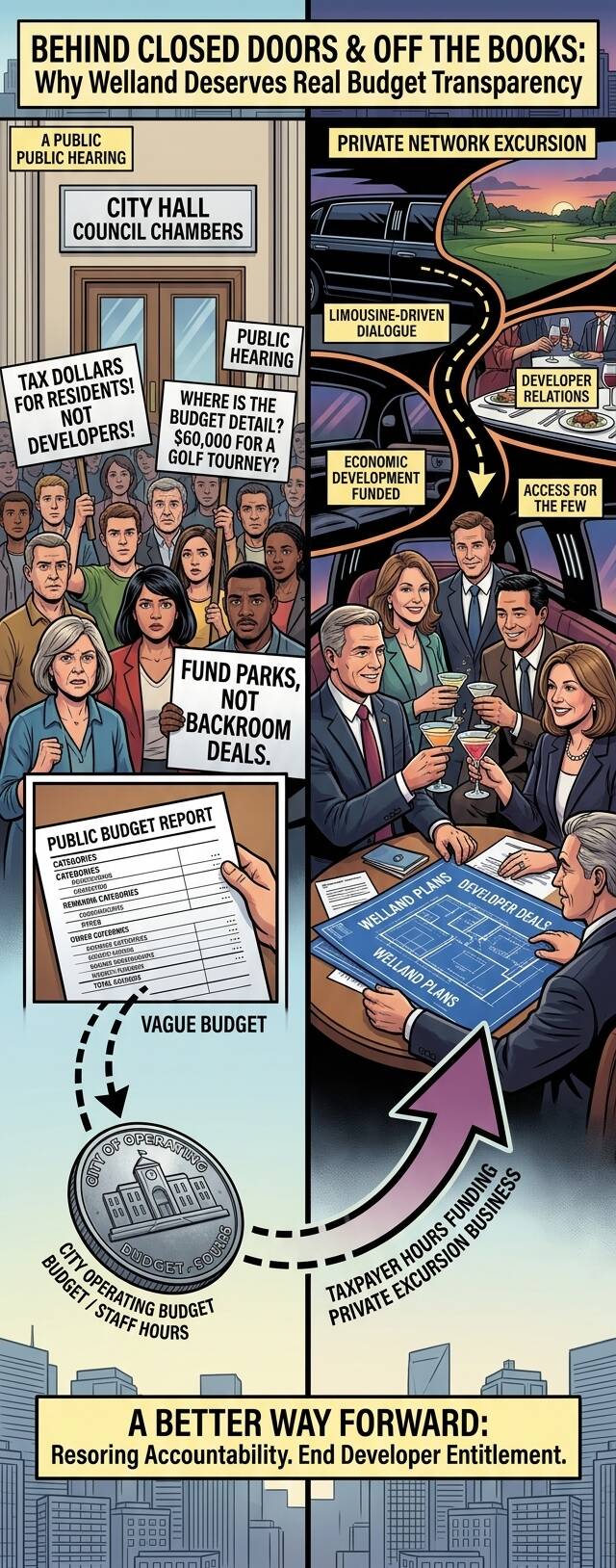
The Paperwork: "Offset by Sponsorships" Is Not the Whole Story
In official municipal reporting—such as the City’s Corporate Partnership disclosures presented in the Council Information Package—the annual Captains of Industry Golf Tournament organized by Economic Development is categorized as "fully funded through sponsorship support." On paper, the City reports that registration entry fees and corporate sponsorships (including documented amounts from entities like Welland Hydro Electric System Corp. and regional post-secondary institutions) offset the tournament's direct event bills.
Saying an event is fully covered by private sponsors on paper does not tell the full story:
- Staff Hours Are Taxpayer Hours: Private sponsorships may pay for greens fees, lunch, and golf carts, but they do not fund the municipal salaries of the staff who organize them. Significant hours from salaried city personnel in Economic Development and administration are devoted to planning, vendor management, outreach, and logistics. Those staff hours are funded by your property taxes.
- Missing Line-Item Detail: If an event is truly self-sustaining through corporate entry packages and hole sponsorships, where is the detailed, publicly published ledger? Taxpayers have no transparent accounting of gross revenue collected, the full roster of registered corporate sponsors, or the real operational breakdown. A one-sentence reporting note stating that an initiative is "offset" is not accountability.
- The Broader Developer Hospitality Budget: As revealed by sitting councillors, tournament networking often ties into a broader series of out-of-town developer dinners and hospitality excursions. Those trips and attraction dinners are frequently expensed directly under municipal Economic Development operating lines.
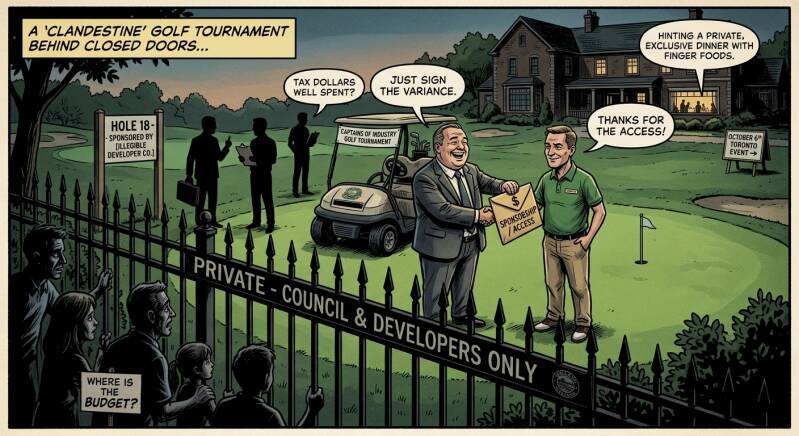
The Procurement Test: When Does Sponsorship Become a Gift?
In the professional purchasing and supply chain world—such as under PMAC / Supply Chain Canada standards and strict public sector procurement rules—accepting gifts, tickets, or hospitality from commercial vendors is an absolute line in the sand.
Why? Because in professional purchasing, the perception of bias is often just as damaging as outright misconduct.
If developers, planning consultants, or construction firms purchase tickets, sponsor holes, or fund lavish banquets where elected officials and senior decision-makers attend for free, we must ask the tough ethical question: Is this not a gift in everything but name?
Under standard municipal Codes of Conduct and the Municipal Act, councillors and staff are explicitly forbidden from accepting gifts, entertainment, or hospitality that could be seen to compromise their impartiality or create an expectation of future consideration.
When a developer spends thousands of dollars sponsoring a tournament that gives them direct, informal face-time with the very people voting on their zoning amendments, official plan changes, and building permits, the public perception is inevitable: it looks like an unwritten contingency—that something will eventually be owed in return.
No developer spends corporate capital out of pure charity without expecting access. When council and staff partake in events subsidized by the development industry, it obliterates the ethical distance required between the regulator and the applicant.
Backrooms and Fairways: The Real Cost to Good Governance
The biggest cost to our city cannot be found simply on an expense receipt; it is the cost to public trust.
Public planning in Ontario is supposed to happen in the open. When developers submit applications for zoning changes, high-density variances, or major subdivision expansions, the public deserves to know that these decisions are evaluated strictly on their merits in public council chambers.
When elected representatives and senior administrators spend entire days on the greens or traveling to exclusive dinners with private developers, it creates an unmistakable perception of access:
- It facilitates back-channel conversations about the future of our neighbourhoods, roads, and infrastructure outside of public delegations and open meetings.
- It excludes everyday residents, neighbourhood advocates, and community volunteers who will never have an invitation to a private golf banquet to share their concerns.
- It breeds cynicism. Taxpayers have every reason to ask: Why are development discussions happening over cocktails and private carts instead of in public committee rooms?
A Better Way Forward: Restoring Accountability
Economic development and attracting responsible investment to Welland are essential goals. However, healthy economic growth does not require backroom access, private outings, or murky accounting.
Welland needs a City Hall that respects public dollars and practices genuine transparency:
- Strict Alignment with Procurement Ethics: Elected officials and municipal staff should be held to the same rigid conflict-of-interest standards as certified procurement professionals. If private developers are funding the event, council should not be attending on their tab.
- A Comprehensive Line-Item Audit: Every event coordinated by municipal staff must have a clear, publicly accessible accounting ledger showing exact sponsor contributions, fee revenue, overhead costs, and city staff hours allocated.
- Prioritizing Community Over Exclusivity: Taxpayer-supported staff time belongs to initiatives that benefit the public—revitalizing our parks, supporting community safety, fixing our roads, and partnering with local volunteer festivals that keep our heritage alive.
- Transparent Planning for All: Planning decisions must occur in public view. Every resident, business owner, and developer should operate on a level playing field, with all discussions documented on public agendas where they belong.
We must preserve the taxpayer's dollar, adhere to professional ethical standards, and hold City Hall to the highest standard of accountability. The future of Welland should be built openly in the public interest, not quietly negotiated on the fairway.
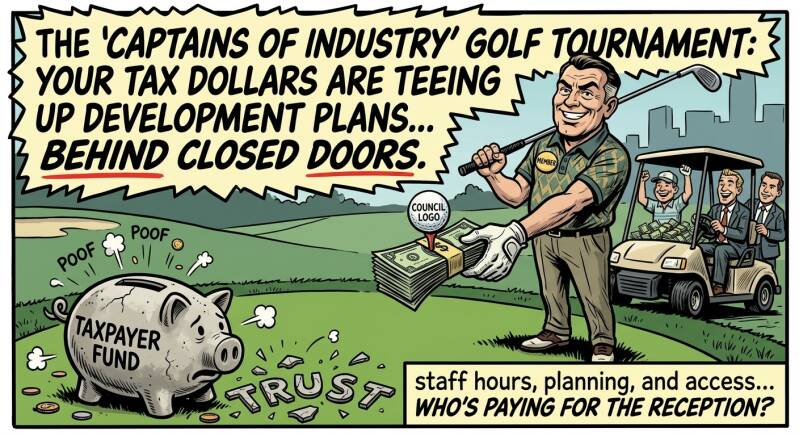
Direct Links to the Official Proof
1. City of Welland Council Information Package (August 21, 2026):
- Link: City of Welland Council Information Package (CIP) – August 21, 2026
- What it proves:
- Confirms the Captains of Industry Golf Tournament as a recurring municipal/economic development initiative.
- Documents that the tournament is listed under the City's Corporate Partnership Policy (SER-008-0010) reporting.
- Contains the official city accounting statement: "The Captains of Industry Golf Tournament, for example, remains fully funded through sponsorship support."
- Contains the Corporate Sponsorship Ledger, which explicitly records Welland Hydro Electric System Corp. contributing $2,500 and Niagara College Canada contributing $1,500 specifically as sponsorships for the Captains of Industry Golf Tournament under Strategic Objective 1.4 ("Improve City Brand").
2. Niagara Catholic District School Board (NCDSB) Committee of the Whole Minutes (January 11, 2022):
- Link: NCDSB Committee of the Whole Official Minutes – January 11, 2022
- What it proves:
- Confirms that this is the "Welland Economic Development Commission's annual Captains of Industry Golf Tournament."
- Documents where proceeds go: records a $2,250.00 donation disbursed on December 14, 2021, directly from tournament proceeds to fund school board community food programs.
When Did the Tournament Start?
The tournament has operated for well over a decade under the Welland Economic Development Commission (EDC). While earlier iterations date back into the 2000s and 2010s as the EDC's signature business-retention event, formal public board and municipal audit records track the named "Captains of Industry Golf Tournament" back continuously through the 2010s and through recent years (2021–2026).
When Is the Next One?
- Annual Cadence: The tournament is traditionally held during the late summer / early autumn golf season (typically late August to September).
- Next Scheduled Occurrence: The 2026 tournament took place in late August/early September, leading into the fall economic development calendar (followed by the October developer attraction session referenced in your correspondence). The next annual iteration will run in late Summer/Autumn 2027.
What Is the Cost to Attend?
Because the tournament is hosted privately as an invitation/business-attraction event by Economic Development rather than an open public recreation scramble:
- Elected Officials & City Staff: City Council members and senior economic development staff attend free of charge as municipal hosts (or under the event's internal hosting budget).
- Corporate & Developer Packages: Participating engineering firms, builders, and corporate partners typically pay tiered entry fees:
- Hole Sponsorships / Corporate Entries: Generally range from $1,500 to $2,500+ (matching the $1,500–$2,500 corporate amounts logged by sponsors like Niagara College and Welland Hydro).
- Individual/Foursome Player Fees: Standard corporate foursomes for this tier of municipal economic tournament historically run between $800 and $1,200 per foursome (or approximately $200 to $300 per individual golfer), which covers greens fees, carts, lunch, and the evening networking dinner.
Add comment
Comments