

Across North America, rural communities on the perimeter of expanding urban boundaries are facing a critical crossroads. When municipal councils weigh short-term economic development against the long-term stewardship of agricultural land and rural water tables, the stakes could not be higher.
In communities like Cook’s Mills—where families drink from private domestic wells, rely on local aquifers, and live alongside active farms, woodlots, and natural creeks—the prospect of heavy industrial rezoning represents an existential threat. To understand what is truly on the line, we need to look no further than recent history, the science of chemical persistence, the legal guardrails established under Ontario planning law, and the generational toll of remediation.
1. The Warning Sign: Corporate Track Records and the Hoosick Falls Crisis
Industrial expansion should never be evaluated on corporate sales pitches alone; it must be measured against past environmental accountability.
Consider the ongoing environmental catastrophe in Hoosick Falls, New York. For decades, manufacturing operations linked to major corporations—including Saint-Gobain Performance Plastics, 3M, Honeywell, and DuPont—utilized perfluorooctanoic acid (PFOA) and related per- and polyfluoroalkyl substances (PFAS) in the production of specialty coatings and polytetrafluoroethylene (PTFE).
How the Contamination Spread
- Atmospheric Deposition & Drainage: Emissions released through industrial smokestacks settled across surrounding agricultural soils, while untreated industrial wastewater entered local drainage ditches and ground systems.
- Aquifer Migration: Because PFAS molecules contain exceptionally strong carbon-fluorine bonds, they do not break down naturally in the environment. Rainwater leached these "forever chemicals" deep into the permeable water table, creating a widespread underground plume.
- Human and Community Exposure: By 2015, municipal drinking water and dozens of private residential wells revealed PFOA levels hundreds of times higher than safe health advisories. Blood testing showed long-time residents carrying chemical concentrations upwards of 30 times national averages.
The Legal and Economic Fallout
The financial liabilities have been massive:
- In 2021, Saint-Gobain, 3M, and Honeywell agreed to a $65.25 million USD class-action settlement to resolve property devaluation and medical monitoring claims.
- In July 2025, DuPont agreed to a separate $27 million USD settlement (alongside an additional $6 million for medical surveillance), bringing the community recovery to more than $90 million USD.
- Similar contamination plumes linked to Saint-Gobain facilities in Merrimack, New Hampshire, and Bennington, Vermont, forced state regulators to mandate tens of millions of dollars in multi-mile water main extensions and private filtration systems.
When industrial operators look to purchase and rezone greenfield agricultural land, their environmental history must be scrutinized with complete transparency.
2. Health Risks: What "Forever Chemicals" and Heavy Industry Mean for Well-Dependent Families
In an urban setting with municipal water treatment plants, complex filtration systems can sometimes be retrofitted at a central facility. In a rural community like Cook’s Mills, every single home acts as its own water treatment plant through a private well.
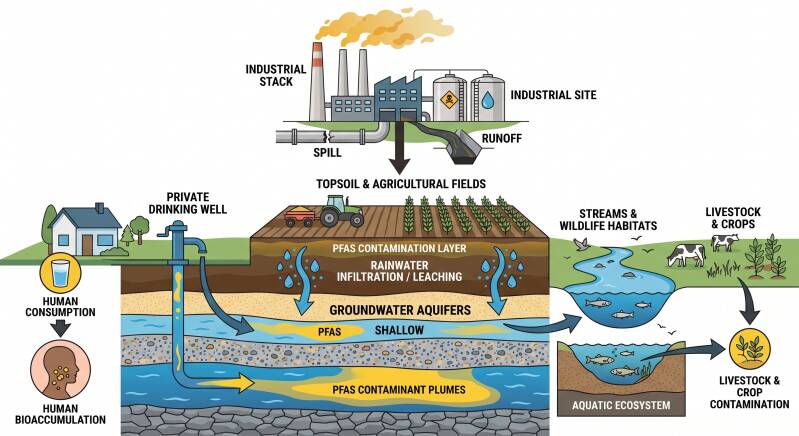
When industrial solvents, heavy metals, or persistent synthetic compounds enter the soil and water table, the health implications are severe:
- Short-Term / Acute Exposure: Increased liver enzymes, compromised immune responses (including reduced vaccine efficacy in children), and elevated serum chemical loads.
- Long-Term / Chronic Illness: Elevated statistical rates of kidney cancer, testicular cancer, thyroid disease, high cholesterol, microvascular dysfunction, and pregnancy-induced hypertension (preeclampsia).
- Bioaccumulation in Food Chains: Contaminated groundwater used to irrigate hay, vegetables, or pasture grasses is absorbed directly into plant tissue. Livestock ingesting impacted forage concentrate these toxins in their dairy and meat, disrupting local food safety.
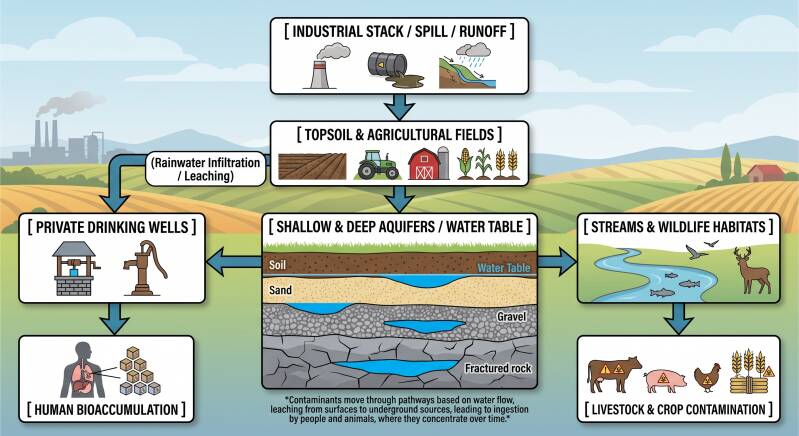
3. The Reality and Staggering Costs of Soil & Water Remediation
Once an aquifer or prime agricultural soil profile is contaminated, the illusion of an "easy cleanup" evaporates. Remediating persistent industrial compounds is technically grueling and financially devastating.
The Engineering Process
- Mass Excavation & High-Heat Thermal Destruction: Traditional bioremediation (using soil microbes) does not degrade fluorinated compounds. Contaminated topsoil and subsoil must be physically dug up, trucked away as hazardous waste, and incinerated in specialized kilns exceeding 1,100°C.
- Perimeter Pump-and-Treat Systems: Multiple interceptor wells must be drilled to continuously pump contaminated groundwater to surface filtration systems utilizing Granular Activated Carbon (GAC) or Ion-Exchange Resins before returning water to the watershed.
- Point-of-Entry Filtration for Every Home: Twin-tank activated carbon filtration systems must be retrofitted to every private wellhead, demanding quarterly laboratory testing and frequent filter media replacements.
The Financial Burden
- Hazardous Excavation: Hauling and disposing of toxic industrial-grade soil regularly costs between $150 and $300+ CAD per cubic meter. A standard multi-acre industrial parcel requiring 25,000 m³ of soil removal can easily cost $5M to $8M CAD in excavation alone.
- Groundwater Treatment Plants: Capital costs for regional pump-and-treat systems run from $3M to $10M CAD, with annual operational and carbon replacement expenses ranging between $250,000 and $800,000 CAD per year for 25 to 40 years.
- Rural Water Infrastructure: Extending municipal water mains through rural concessions to replace poisoned private wells costs approximately $500,000 to $1.5M CAD per linear kilometer, easily driving emergency municipal utility extensions into the tens of millions.
- Agricultural & Property Devaluation: Real estate stigma and loss of organic/agricultural certification can devalue farmland and rural residences by 20% to 50%, destroying the generational wealth of local farming families.
4. Ontario’s Environmental and Planning Safeguards: The Rules of Rezoning
Industrial developers cannot simply purchase agricultural acreage and begin building. Ontario maintains strict planning and environmental frameworks designed to protect agricultural systems, rural water supplies, and sensitive ecosystems.
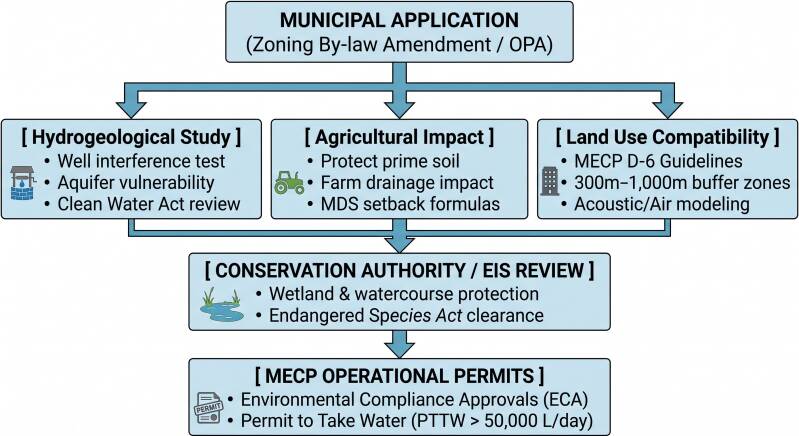
Provincial Planning Statement & The Planning Act
- Prime Agricultural Protection: Agricultural land is designated for long-term food production. Converting prime agricultural areas to non-agricultural uses requires comprehensive municipal justification, proving that no suitable alternative lands exist within existing urban boundaries.
- Agricultural Impact Assessments (AIA): Proponents must formally evaluate how industrial traffic, artificial lighting, drainage changes, and potential emissions will affect adjacent farm operations.
- Minimum Distance Separation (MDS) Formulae: Ensures mandatory setback buffers between agricultural operations and new non-farm land uses.
Technical Environmental Studies
Before any rezoning application can be deemed complete, a battery of peer-reviewed technical reports is legally required:
- Hydrogeological & Well Interference Assessment: Hydrogeologists must map baseline water table depths, verify groundwater recharge areas, and conduct pumping tests to prove industrial operations will not deplete or contaminate adjacent domestic wells.
- Source Water Protection (Clean Water Act): If an application sits within a vulnerable aquifer or Wellhead Protection Area, high-risk chemical storage, solvent use, or fuel handling can be restricted or prohibited by law.
- MECP D-6 Compatibility Guidelines: Regulates industrial classifications. Heavy (Class III) industrial operations require a mandatory 1,000-metre Influence Area and a minimum 300-metre continuous setback buffer from sensitive rural homes and livestock operations.
- Environmental Impact Studies (EIS): Evaluates local tributaries, woodlots, and natural heritage features, requiring direct review and clearance by the local Conservation Authority.
5. Opinion: Standing Up for Our Land, Water, and Community at City Hall
Economic growth and job creation are important goals for any municipality. But true progress cannot be achieved by sacrificing our irreplaceable natural resources, threatening our rural drinking water, or destroying prime agricultural soil.
Once prime agricultural topsoil is paved over or contaminated by heavy industrial operations, it is gone forever. Once an underground aquifer is compromised, no settlement check can instantly undo the damage to our health, our families, or the wildlife that depends on our local streams.
As a lifelong resident of our community who grew up in the rural beauty of Cooks Mills, I understand firsthand how vital our private wells, our creeks, and our open farmlands are to our daily lives. If given the honour of serving as your Ward 1 Councillor on October 26, 2026, I will be an uncompromising champion for doing what is right at City Council:
- Holding the Line on Agricultural & Heritage Protections: We must firmly oppose short-sighted zoning conversions that hand over our prime farmlands to heavy, high-risk industrial developments.
- Protecting Food Security and Local Ecosystems: Niagara’s soil is among the richest in the country. We must ensure our agricultural corridors are protected so future generations have food security and clean natural habitats.
- Defending Our Water Table: Every development proposal must undergo rigorous, transparent, and independent hydrogeological review. We cannot allow industrial experiments to put our residential drinking wells at risk.
- Demanding Genuine Accountability: We must scrutinize corporate environmental track records before even considering land-use changes. Our municipal government exists to protect the long-term well-being of its residents, not to absorb the environmental liabilities of heavy industry.
Add comment
Comments