

Have you ever wondered who to call when a pothole needs filling, why your garbage collection rules change, or where your property tax dollars actually go?
In Canada, government responsibilities are divided among different tiers so that decisions are made at the appropriate scale—from national defense down to local streetlights. In Ontario, this system has a unique structure because local government is often split into two tiers: an upper-tier (Regional) government and a lower-tier (Local Municipal) government.
Understanding this division makes it much easier to access community services, advocate for neighborhood improvements, and participate effectively in civic life. Here is a clear, comprehensive breakdown of how each level works, with a deep dive into navigating your local City Hall.
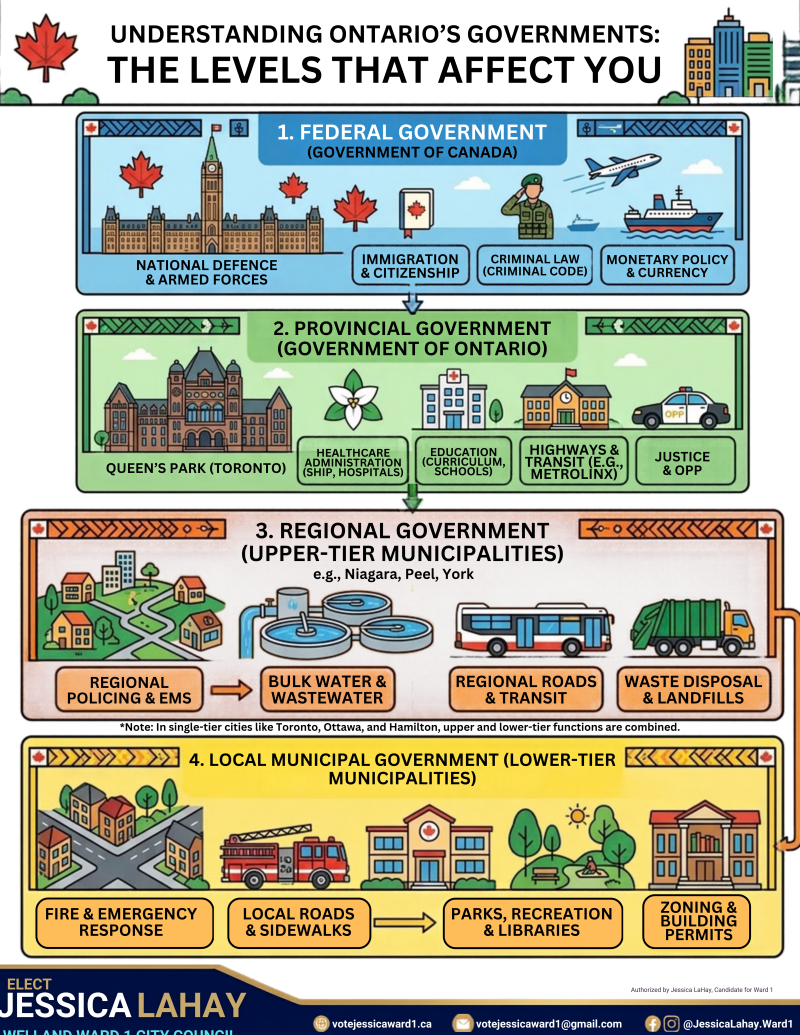
1. Federal Government (Government of Canada)
-
Seat of Government: Parliament Hill, Ottawa
-
Key Leadership: Prime Minister and Members of Parliament (MPs)
-
Core Focus: National affairs, international relations, and issues that cross provincial and international borders.
The federal government handles matters that affect the country as a whole. Under the Canadian Constitution, its responsibilities include:
-
National Defence & Armed Forces: Protecting Canada’s sovereignty and participating in international peacekeeping and defense alliances (e.g., NORAD, NATO).
-
Foreign Affairs & Trade: Managing diplomatic relationships, international treaties, and international trade agreements.
-
Immigration, Passports & Citizenship: Overseeing permanent residency, refugee settlement, citizenship processing, and border security.
-
Criminal Law: Creating and amending the Criminal Code of Canada (which applies uniformly across every province and territory).
-
Monetary Policy & Currency: Directing national economic policy via the Bank of Canada and minting currency.
-
Federal Infrastructure & Networks: Telecommunications, aviation, interprovincial railways, and major marine ports.
2. Provincial Government (Government of Ontario)
-
Seat of Government: Queen’s Park, Toronto
-
Key Leadership: Premier and Members of Provincial Parliament (MPPs)
-
Core Focus: Regional social policy, major public institutions, civil rights, and province-wide standards.
Under the Constitution, provinces are responsible for public services that directly shape daily quality of life, as well as setting the legal rules that govern all municipalities:
-
Healthcare Administration: Funding hospitals, managing OHIP, directing long-term care regulations, and overseeing public health mandates.
-
Education & Post-Secondary: Setting the curriculum for elementary and secondary schools, funding district school boards, and regulating colleges and universities.
-
Highways & Regional Transit: Constructing and maintaining provincial 400-series highways and overseeing provincial transit authorities (such as Metrolinx/GO Transit).
-
Justice & Provincial Policing: Administering the provincial court system, correctional facilities, and deploying the Ontario Provincial Police (OPP) in designated jurisdictions.
-
Municipal Legislation: Setting the rules for local governments through the Municipal Act and the Planning Act. Local towns and regions exist by virtue of provincial law.
The Big Split: Regional vs. Local Municipal Government
In many parts of Ontario (such as Niagara, Peel, York, Durham, and Halton), local governance operates under a two-tier system:
-
Upper-Tier (Regional Municipality)
-
Lower-Tier (City, Town, or Township)
Rather than duplicating work, the two tiers split duties based on scale. The Region manages large-scale, capital-intensive infrastructure and coordinated services across several municipalities. The Local Municipality handles community-level services, neighborhood maintenance, and direct resident requests.
(Note: In single-tier cities such as Toronto, Ottawa, and Hamilton, these two levels are merged into one single city council.)
TWO-TIER LOCAL GOVERNANCE
| UPPER-TIER (REGIONAL COUNCIL) | LOWER-TIER (LOCAL CITY COUNCIL) |
|---|---|
| Regional Roads & Traffic Lights | Local Residential Streets |
| Public Transit System | Sidewalks & Street Sweeping |
| Bulk Water Treatment & Trunks | Local Water Distribution Pipes |
| Waste Collection & Landfills | Fire & Emergency Services |
| Regional Police & Paramedics | Parks, Playgrounds & Arenas |
| Social Housing & Public Health | Local Zoning, Permits & Bylaws |
3. Regional Government (Upper-Tier Municipality)
-
Governing Body: Regional Council (led by a Regional Chair and composed of Mayors and elected Regional Councillors from local towns/cities).
-
Core Focus: Large-scale infrastructure, shared regional services, emergency medical response, and social safety nets across multiple municipalities.
Regional governments manage services that require significant economies of scale, extensive geographic coordination, or collective financing:
-
Regional Police & Paramedic Services: In two-tier regions, policing (e.g., Niagara Regional Police Service) and Paramedics (EMS) operate at the regional level, ensuring consistent emergency standards across all constituent municipalities.
-
Regional Transit: Integrated regional transit networks connect urban cores, rural areas, and post-secondary campuses under a unified fare and route structure.
-
Bulk Water & Wastewater Treatment: The Region manages large water purification plants, regional trunk mains, and wastewater treatment facilities to ensure clean, safe tap water before it enters local networks.
-
Waste Management, Recycling & Landfills: Curbside garbage pick-up, green bins, blue boxes, hazardous waste depots, and landfill operations are organized by the upper-tier government.
-
Social Services & Community Support: Managing subsidized community housing, emergency shelters, child care fee subsidies, seniors’ long-term care homes, and Regional Public Health units.
-
Regional Arterial Roads: Constructing, repaving, plowing, and timing signals on major regional routes and trucking corridors that connect neighboring municipalities.
4. Deep Dive: Local Municipal Government (Lower-Tier Municipality)
-
Governing Body: Local City / Town Council (led by the Mayor and local Ward Councillors).
-
Core Focus: Day-to-day neighborhood livability, community amenities, local safety, and frontline resident services.
Your local City Hall is the government level closest to the people. It shapes the tangible environment you interact with the moment you walk out your front door.
Detailed Breakdown of Municipal Services
-
Fire & Emergency Response:
-
Unlike police and paramedics (which are regional), municipal fire services are locally operated.
-
Firefighters handle structural fire suppression, medical first-response tiering, hazardous material mitigation, water/ice rescue, and local emergency planning.
-
Municipal fire prevention officers conduct safety inspections, enforce the Ontario Fire Code in local businesses and apartments, and run community smoke-alarm initiatives.
-
-
Neighborhood Roads, Sidewalks & Active Transportation:
-
While regions manage high-volume highways and regional arteries, City Hall is responsible for local subdivision streets, cul-de-sacs, and downtown avenues.
-
Services include local asphalt resurfacing, winter plowing and salting, pothole patching, sidewalk repairs, street sweeping, local crosswalks, traffic calming (such as speed humps), and neighborhood bike paths.
-
-
Parks, Urban Forestry & Public Spaces:
-
Municipalities design, maintain, and upgrade community parks, splash pads, sports fields, pickleball and tennis courts, skateparks, and dog parks.
-
City arborists and forestry teams manage the urban tree canopy, trimming city trees, planting native street trees, and removing hazardous limbs.
-
-
Recreation Facilities, Community Programming & Culture:
-
Operation of municipal community centers, indoor ice arenas, public indoor and outdoor swimming pools, and senior centers.
-
Local governments oversee recreational leagues, swimming lessons, summer day camps, community event permits, and municipal heritage sites or civic museums.
-
-
Local Water Distribution & Stormwater Drainage:
-
While the Region purifies bulk water and treats sewage, the local municipality owns and repairs the secondary water mains under your street, individual water meters, fire hydrants, stormwater retention ponds, roadside ditches, catch basins, and culverts.
-
-
Planning, Building Permits & Economic Development:
-
Planning: Managing the local Official Plan, evaluating subdivision applications, and determining local zoning bylaws (what can be built where—residential, commercial, or industrial).
-
Building Division: Issuing permits and conducting on-site structural/plumbing inspections for home renovations, additions, basement apartments, and new construction to guarantee adherence to the Ontario Building Code.
-
Economic Development: Attracting local commercial investment, supporting small businesses, and revitalizing downtown business improvement areas (BIAs).
-
-
Bylaw Enforcement & Animal Care:
-
Ensuring neighborhood safety and civility by enforcing property standards (e.g., long grass, derelict vehicles, structural decay), residential noise limits, on-street parking regulations, and short-term rental rules.
-
Regulating pet licensing, animal control, and off-leash park standards.
-
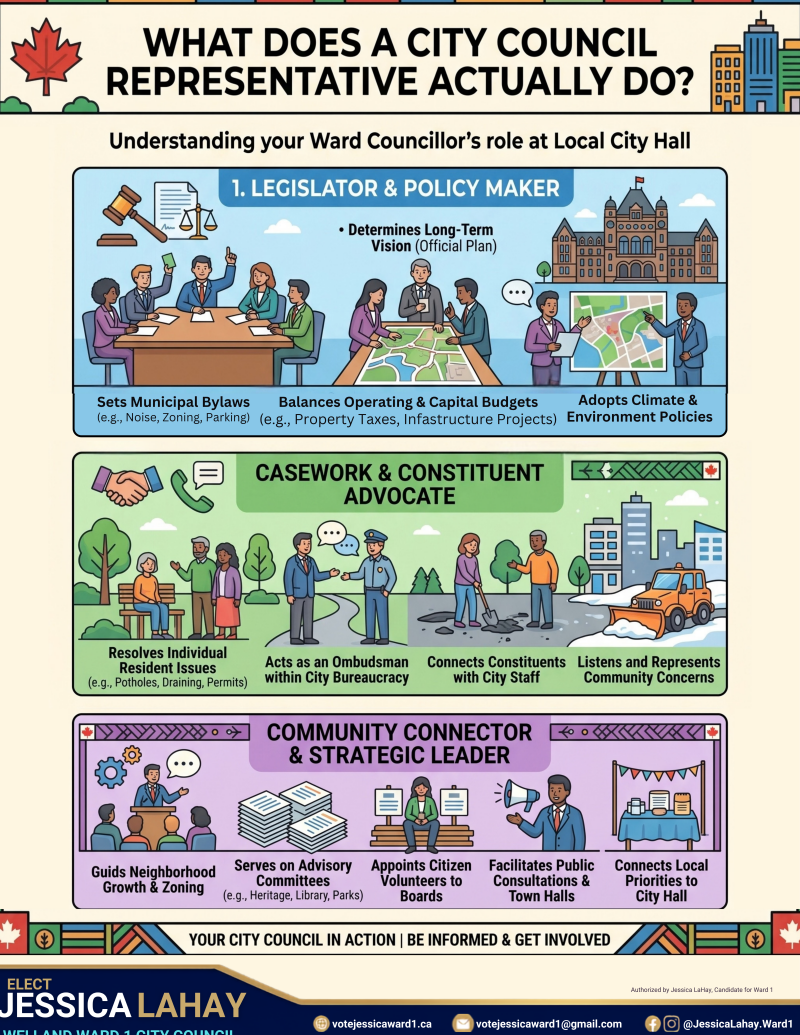
What Does a City Council Representative Actually Do?
Many residents only think of their local councillor during an election, but your City Council representative (often called a Ward Councillor) has an active, multifaceted role:
| THE THREE ROLES OF A COUNCILLOR |
|---|
| 1. LEGISLATOR: Debates bylaws, sets city policy, balances budgets |
| 2. CASEWORK ADVOCATE: Resolves resident issues with city bureaucracy |
| 3. COMMUNITY CONNECTOR: Channels neighborhood priorities to City Hall |
-
Setting Municipal Policy and Legislation:
Councillors introduce, debate, and vote on municipal bylaws—from noise regulations and parking restrictions to secondary dwelling policies and climate adaptation strategies.
-
Fiduciary Duty and Approving the Operating & Capital Budgets:
Every year, council reviews hundreds of municipal spending lines. They balance the need for infrastructure repair, recreation, and emergency services against property tax impacts and water wastewater rates. They decide when to invest in a new arena, repave a deteriorating road, or purchase new fire rescue equipment.
-
Casework and Navigating Red Tape for Residents:
A core duty of a councillor is constituent service. When a resident cannot get traction on an unresolved drainage issue, has concerns about dangerous speeding near a school, or faces confusion with a building permit, their councillor acts as an ombudsman—connecting them directly with senior city staff and following up until the issue is addressed.
-
Guiding Neighborhood Growth and Zoning:
Councillors sit on planning committees and public hearings. They weigh developers' proposals against the interests of existing residents, advocating for adequate green space, parking solutions, traffic mitigation, and smart infill development.
-
Committee Service and Strategic Leadership:
Beyond regular bi-weekly council meetings, representatives serve on specialized boards and committees (e.g., Heritage Advisory Committees, Library Boards, Committee of Adjustment, Downtown BIAs, and Active Transportation Committees).
How the Average Taxpayer Can Get Involved
Municipal government is by far the most accessible level of public office. A single engaged resident or neighborhood group can directly alter a council decision. Here is how you can make your voice heard:
-
1. Speak at Council (Register as a Delegation):
You don't have to just watch council meetings—you can participate. Every municipality allows residents to register as a "delegation" to speak directly to the Mayor and Council on agenda items (usually for 5 to 10 minutes). Whether you support or oppose a proposed development, transit change, or budget line, registering to speak puts your perspective directly on public record.
-
2. Attend Public Open Houses & Statutory Public Meetings:
When a city updates its Official Plan, redesigns a park, or reviews a major rezoning application, it is legally required to host public consultations. Attending these sessions lets you review architectural site plans, ask engineers and planners questions, and submit written feedback before plans are finalized.
-
3. Contact Your Ward Councillor Directly:
Unlike federal or provincial leaders who represent tens or hundreds of thousands of people, ward councillors represent neighborhood-scale populations. Call or email them. If you notice a blind intersection, a recurring water ponding issue, or want to suggest playground equipment, reach out. Be specific, constructive, and clear about the location and impact.
-
4. Join a Municipal Advisory Committee or Board:
Cities rely on citizen volunteers to guide council decisions. You can apply to sit on boards such as:
-
Committee of Adjustment (minor variances and land consents)
-
Municipal Heritage Advisory Committee
-
Accessibility Advisory Committee
-
Environmental & Climate Advisory Committee
-
Public Library Board
-
Parks and Recreation Advisory Committee
-
-
5. Participate in the Annual Budget Consultations:
Every autumn, municipalities release draft budget targets and host public surveys or town halls. This is your chance to state whether you want to see investments prioritized in road resurfacing, park maintenance, climate resilience, or tax stabilization.
-
6. Track Agendas, Watch Livestreams, and Vote:
City Council agendas and staff reports are published publicly online several days before every meeting. Reviewing them keeps you informed about neighborhood changes before shovels hit the ground. And every four years in October, cast your ballot in the municipal election—the election that arguably has the most immediate impact on your day-to-day surroundings.
Everyday Scenarios: Who Do You Call?
| SITUATION | WHO HANDLES IT? | WHY? |
|---|---|---|
| Pothole on your quiet residential street | Local City Hall | Residential streets and interior subdivision roadways fall under lower-tier public works. |
| Pothole or broken signal on a major regional artery | Regional Government | Inter-municipal corridors are maintained directly by the upper-tier roads department. |
| Garbage, blue box, or yard waste wasn't collected | Regional Government | Waste management contracts and collection schedules are run by the Region. |
| You want to build a deck or renovate your basement | Local City Hall | Building permits and zoning compliance are handled by the local municipal building department. |
| Public bus schedules, routes, or fares | Regional Government | Transit networks operate as a consolidated regional transit system. |
| A dispute over high grass or neighborhood noise | Local City Hall | Local municipal bylaw enforcement handles neighborhood nuisance complaints. |
| Ambulance / emergency medical response | Regional Government | Paramedics/EMS are managed and dispatched through regional public health and emergency services. |
| Fire safety inspections or smoke alarm questions | Local City Hall | Fire services remain under local municipal command. |
Resource Summary & Contact Directory
Keep this directory handy to quickly report issues, contact elected representatives, or access frontline departments at every level of government.
Federal & Provincial Services
-
Government of Canada / Service Canada:
-
Website: canada.ca
-
General Inquiries & Service Canada: 1-800-O-Canada (1-800-622-6232) / TTY: 1-800-926-9105
-
Passports: 1-800-567-6868
-
Employment Insurance (EI): 1-800-206-7218
-
Canada Revenue Agency (Personal Taxes): 1-800-959-8281
-
-
Elections Canada:
-
Website: elections.ca | Toll-Free: 1-800-463-6868
-
-
Government of Ontario / ServiceOntario:
-
Website: ontario.ca
-
General Information: 1-800-267-8097 (Toll-Free) or 416-326-1234 | TTY: 1-800-268-7095
-
Health Card & Driver Licensing Inquiries: 1-888-376-5197
-
-
Elections Ontario:
-
Website: elections.on.ca | Toll-Free: 1-888-668-8683
-
Niagara Region (Upper-Tier Municipality)
General Regional Inquiries & Headquarters:
-
Website: niagararegion.ca
-
Main Switchboard: 905-980-6000 | Toll-Free: 1-800-263-7215
-
Regional Clerk’s Office (Council Agendas & Regional Delegations): 905-980-6000 ext. 3220
-
Waste Management & Recycling:
-
Regional Waste Info-Line (Collection schedules, missed pickups): 905-356-4141 | Toll-Free: 1-800-594-5542
-
Large Household Item Pick-Up / Miller Waste Systems (Welland Contractor): 1-833-621-0726
-
Humberstone Landfill (Welland Site): 905-356-4141
-
-
Emergency & Public Health Services:
-
Niagara Regional Police Service (NRPS):
-
Emergency: 9-1-1
-
Non-Emergency Central Dispatch: 905-688-4111
-
-
Niagara EMS (Paramedic Services Administration): 905-980-6000 ext. 5099 (Medical Emergencies: 9-1-1)
- Public Health & Social Services Info-Line: 905-688-8248 | Toll-Free: 1-888-505-6074
-
-
Niagara Transit (Regional Public Transit):
-
Customer Service & On-Demand Dispatch: 1-833-NRT-LINE (1-833-678-5463)
-
City of Welland (Lower-Tier Municipality)
-
Civic Square (City Hall Main Switchboard):
-
Address: 60 East Main Street, Welland, ON L3B 3X4
-
General Phone: 905-735-1700
-
Toll-Free TTY: 1-866-273-5094
-
Email: info@welland.ca
-
-
Department Extensions & Direct Contacts:
-
Mayor’s Office: 905-735-1700 ext. 2101
-
Office of the City Clerk (Registering as a delegation, council agendas, elections): 905-735-1700 ext. 2154 or 2155
-
Planning & Development Division (Zoning, minor variances, official plan): 905-735-1700 ext. 2251 or ext. 2257
-
Building Division (Permits, renovations, code inspections): 905-735-1700 ext. 2223
-
Bylaw Enforcement (Property standards, noise complaints, parking): 905-735-1700 ext. 2224
-
Public Works (Residential roads, potholes, municipal trees, snow clearing): 905-735-1700 ext. 3000
-
Recreation, Facilities, Sport & Culture (Community centres, rentals, programs): 905-735-1700 ext. 4000
-
Finance & Property Taxes: 905-735-1700 ext. 2160
-
-
Welland Fire and Emergency Services:
-
Emergency: 9-1-1
-
Fire Headquarters (General Inquiries & Fire Prevention): 905-735-1700 ext. 2400
-
Add comment
Comments