

As a resident of Welland, you have the power to shape the future of our community. Municipal elections are our critical opportunity to make our voices heard on the issues that hit closest to home—from the streets we drive on and the parks our children play in, to how we protect our air, water, and green spaces.
Across Niagara, we are surrounded by incredible natural beauty. But with rapid growth underway, our local choices carry real consequences. Having grown up in Cooks Mills and lived in Ward 1 for over fifteen years, I have seen our community face these growing pains firsthand—from the ongoing pressure to carve up prime rural acreage for industrial parks to the threat of overburdening our infrastructure with unchecked sprawl. We have a clear responsibility to protect what makes this region special while building a thriving, resilient community.
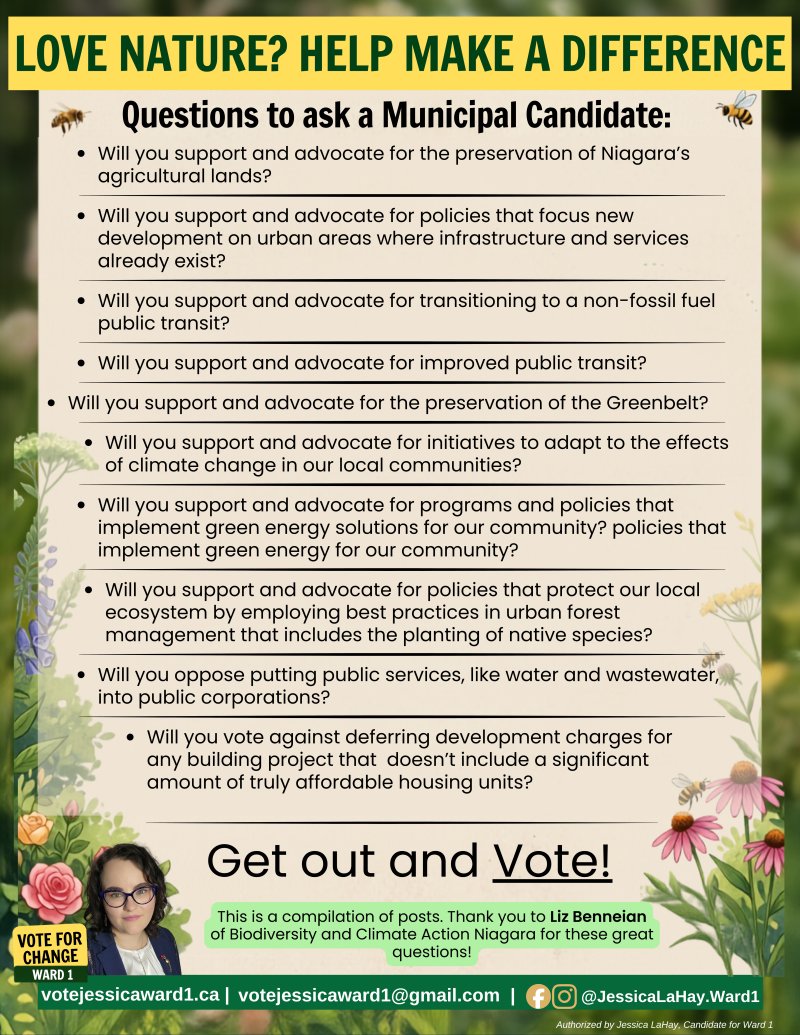
Before casting a ballot, voters deserve to know where every candidate stands on environmental stewardship and sustainable planning. Dedicated environmental advocates—including Liz Benneian and the team at Biodiversity and Climate Action Niagara—have posed essential questions to municipal candidates across our region.
As your candidate for Welland City Council in Ward 1, I believe real leadership begins with direct answers, total accountability, and a proven track record of where you’ve stood when it mattered—not just what is promised at election time. Below is where I stand on every question, backed by my record and direct commitments to our community:
1. Preserving Niagara’s Agricultural Lands
-
Question: Will you support and advocate for the preservation of Niagara’s agricultural lands?
My Answer: Yes.
My Commitment & Governance Stance:
Niagara is home to some of the most fertile, irreplaceable specialty-crop and agricultural soil in Canada. When working farmland is paved over for subdivisions or industrial parks, that food-producing capacity is lost permanently. As your Ward 1 Councillor, I will champion strict urban boundary enforcement, protect our agricultural zoning, and oppose any moves that compromise our rural heritage and regional food sovereignty.
My Record of Action:
Defending our farmland isn't a theoretical exercise for me—it is personal. In 2021, I was on the front lines in Cooks Mills, speaking out publicly, collecting petition signatures, and protesting against the unfair expropriation of Marsha’s land. And again this year, I stood shoulder-to-shoulder with our neighbours to fight another battle against the City of Welland, challenging attempts to redesignate prime agricultural land into industrial and employment lands. I will bring that same relentless backbone to City Hall.
2. Smart Infill Development Over Urban Sprawl
Question: Will you support and advocate for policies that focus new development on urban areas where infrastructure and services already exist?
My Answer: Yes.
My Commitment & Governance Stance:
Expanding outward into greenfields creates massive, long-term taxpayer liabilities for water mains, road maintenance, stormwater management, and emergency coverage. Responsible governance means focusing development inward—prioritizing brownfield remediation, gentle density, and transit-oriented infill where municipal water, wastewater, and roads are already in place. Growing within our existing urban footprint revitalizes neighbourhoods while keeping municipal taxes sustainable.
My Record of Action:
Through my professional experience operating a landscape design and contracting business, I work directly with grading plans, infrastructure constraints, and municipal planning realities. I understand how development impacts the ground beneath our feet. I have consistently advocated against reckless boundary expansions and pushed for development policies that revitalize underutilized commercial corridors before breaking ground on natural spaces.
3. Transitioning to Non-Fossil Fuel Public Transit
Question: Will you support and advocate for transitioning to a non-fossil fuel public transit?
My Answer: Yes.
My Commitment & Governance Stance:
Modernizing municipal and regional transit fleets is essential to reducing localized carbon emissions and improving air quality in our neighbourhoods. I commit to advocating for fleet replacement schedules that transition diesel buses to zero-emission and electric transit models, aggressively pursuing provincial and federal green infrastructure grants so this technological transition saves taxpayers money on long-term fuel and maintenance without overburdening the local property tax levy.
My Record of Action:
In running business operations and coordinating large-scale community events, I have always prioritized forward-looking planning and sustainable logistics. I understand asset life cycles and will bring a practical, financially disciplined approach to regional transit tables to ensure Welland actively secures zero-emission transit funding.
4. Improving Public Transit Access and Reliability
Question: Will you support and advocate for improved public transit?
My Answer: Yes.
My Commitment & Governance Stance:
A well-functioning city cannot leave residents stranded or entirely reliant on personal vehicles. Transit equity is an economic and social issue. I will push for dependable service frequencies, better evening and weekend routes, safe and accessible shelters, and reliable connections into the consolidated Niagara Region Transit network so residents can easily get to work, medical appointments, and school.
My Record of Action:
During my decade working in administrative operations supporting youth, families, and community members, I saw firsthand how unreliable transit limits access to employment, education, and essential care. Having navigated provincial administrative frameworks and community needs, I have consistently advocated for vulnerable residents and will fight to ensure Ward 1 transit service is treated as an essential service, not an afterthought.
5. Defending the Greenbelt
Question: Will you support and advocate for the preservation of the Greenbelt?
My Answer: Yes.
My Commitment & Governance Stance:
The Greenbelt is an ecological buffer that protects sensitive wetlands, filters groundwater, mitigates regional flood risks, and preserves our natural heritage. I am unequivocally committed to defending the integrity of the Greenbelt. I will vote against any municipal motion, planning scheme, or provincial request that seeks to carve out, swap, or compromise protected Greenbelt parcels for speculative development.
6. Climate Change Adaptation in Local Communities
Question: Will you support and advocate for initiatives to adapt to the effects of climate change in our local communities?
My Answer: Yes.
My Commitment & Governance Stance:
Climate adaptation isn't theoretical; it is tangible, neighbourhood-level municipal work. More frequent high-intensity rainstorms and heat waves put immense strain on our local infrastructure. My governance focus is on climate-resilient civil assets: updating storm capacity modeling, prioritizing proactive ditch and culvert maintenance, expanding permeable public surfaces, and integrating naturalized bioswales to prevent localized flooding and protect homeowners from catastrophic overland water damage.
My Record of Action:
Having lived both in rural Cooks Mills and Ward 1, I know the persistent headaches of inadequate stormwater ditching, standing water, and aging culverts. Through my background in landscape construction, I bring practical knowledge of soil permeability, water grading, and stormwater retention to council debates to ensure our capital budgets prioritize flood prevention where neighbourhoods are most vulnerable.
7. Implementing Green Energy Solution
Question: Will you support and advocate for programs and policies that implement green energy solutions for our community?
My Answer: Yes.
My Commitment & Governance Stance:
City Hall should lead by example by reducing its own environmental and fiscal footprint. I support municipal energy policies that incorporate solar installations, heat pump conversions, and energy-efficiency retrofits across city arenas, community centres, and civic facilities. Additionally, I will advocate for local programs that connect homeowners, landlords, and local business owners with existing energy-retrofit grants to lower their operating expenses and utility bills.
My Record of Action:
As a small business owner, I manage overhead through energy-conscious choices and disciplined resource management. At City Hall, I will bring that same pragmatic lens: backing green energy initiatives that produce verified cost savings for taxpayers while shrinking municipal energy consumption.
8. Urban Forest Management and Planting Native Species
Question: Will you support and advocate for policies that protect our local ecosystem by employing best practices in urban forest management that includes the planting of native species?
My Answer: Yes.
My Commitment & Governance Stance:
Our urban tree canopy is a frontline defense against urban heat islands and severe stormwater runoff. I commit to championing an aggressive urban forest management strategy that protects mature trees from clear-cutting and mandates that all municipal tree plantings prioritize native species adapted to our Carolinian eco-zone. Native plantings create biodiversity corridors, support pollinators, and require significantly less water and chemical intervention to thrive.
My Record of Action:
This issue is directly aligned with my professional career and community service. As the owner of a landscape design company and former Vice Chair of the Welland Heritage Advisory Committee, I have spent years working with plant species, soil biology, and site designs tailored specifically to our regional ecosystem. I understand the real ecological and monetary cost when municipalities choose low-quality, invasive, or unsuitable ornamental plantings instead of durable native canopies.
9. Keeping Water and Wastewater in Public Hands
Question: Will you oppose putting public services, like water and wastewater, into public corporations?
My Answer: Yes.
My Commitment & Governance Stance:
Clean, reliable drinking water and safe wastewater collection are foundational public health necessities—they should never be treated as commercial balance-sheet assets or corporate revenue vehicles.
Across Ontario, municipalities periodically face calls from consultants and developers to spin public utilities off into Municipal Services Corporations (MSCs). While proponents pitch corporatization as a workaround to borrow money outside municipal debt caps, the real-world consequence is often an erosion of local democracy:
-
Preserving Democratic Accountability: Under our current municipal model, utility budgets, capital replacement schedules, and rate structures must be debated and voted on by your elected City Council in open, public chambers. Transferring these assets to an arm’s-length corporation places critical decisions behind closed corporate boardroom doors, diluting public oversight and municipal accountability.
-
Protecting Household Affordability: Working families and seniors across Welland are already managing sharp cost-of-living increases and rising municipal utility rates. Corporatized utility models introduce duplicate administrative overhead, corporate governance costs, and commercial debt structures that historically drive up user distribution and consumption fees.
-
Prioritizing Public Health Over Corporate Metrics: Water infrastructure decisions must be driven by community need, water quality testing, and environmental safety—not corporate debt servicing or balance-sheet optimization.
Welland’s water distribution and wastewater collection infrastructure belongs entirely to the residents who have paid for it across generations. As your Ward 1 Councillor, I will unequivocally oppose any initiative to transfer, corporatize, or privatize our water and wastewater systems. They must remain 100% publicly owned, publicly operated, and directly answerable to the people of Welland.
10. Prioritizing Truly Affordable Housing
Question: Will you vote against deferring development charges for any building project that doesn’t include a significant amount of truly affordable housing units?
My Answer: Yes.
My Commitment & Governance Stance:
Development charges are the primary financial mechanism that ensures growth pays for growth—funding the water mains, parks, fire services, and road capacity that new developments demand. Deferring or waiving these fees without ironclad community returns simply shifts that infrastructure bill onto current property taxpayers. If private developers ask City Council for concessions or charge deferrals, they must be legally bound to deliver deeply affordable, accessible housing units that meet the actual needs of local working families and seniors.
My Record of Action:
I have consistently voiced that taxpayer dollars, public assets, and municipal incentives must not subsidize luxury or market-rate developments that do nothing to solve our local housing crunch. Council’s priority must be protecting existing residents' wallets while ensuring that housing affordability initiatives produce genuine, long-term, below-market homes.
Make Your Voice Heard This Election
Local government decisions directly affect your quality of life, your property taxes, and the preservation of our community's green spaces.
Take these questions with you when candidates knock on your door, bring them to community debates, and make sure your vote reflects the future you want for Welland.
If you would like to discuss these issues, share your concerns, or talk about priorities in your neighbourhood, I encourage you to connect with me:
-
Website: votejessicaward1.ca
-
Email: votejessicaward1@gmail.com
-
Social Media: @JessicaLaHay.Ward1
Add comment
Comments