

The Power of Local Decisions: Why Municipal Politics Matter Most
When people discuss politics, national and provincial headlines usually dominate the conversation. Yet the decisions that impact your everyday routine—from the moment you turn on your tap in the morning to how your street is plowed after a winter storm—are made right here at Civic Square.
Local government is not an abstract concept; it is the foundation of our daily living:
-
Your Tax Dollars at Work: City Council determines how municipal property tax dollars are allocated, balancing infrastructure needs, community programming, and fiscal sustainability.
-
Core Infrastructure: Council decides which roads get repaved, how water and wastewater systems are upgraded, and how transit routes serve growing neighbourhoods.
-
Neighbourhood Growth & Character: Zoning bylaws, housing density, urban sprawl, and development applications are vetted and approved at the local level, defining what our community looks like for generations.
-
Quality of Life: From maintaining local parks, splash pads, and community centres to preserving local heritage and funding emergency fire services, local decisions shape community safety and well-being.
Despite this direct impact, municipal elections consistently suffer from the lowest voter engagement of any level of government.
Two Decades of Disengagement: The Welland Reality
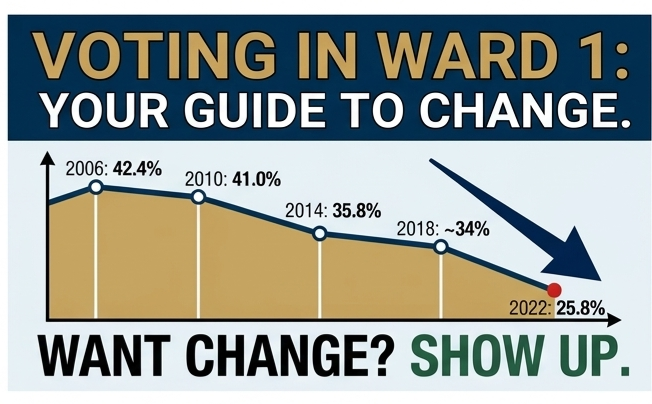
Over the last twenty years, voter participation in Welland has seen a persistent, troubling decline:
-
2006: 42.4%
-
2010: 41.0%
-
2014: 35.8%
-
2018: ~34.0%
-
2022: 25.8%
In 2006, over four in ten residents cast a ballot. By 2022, turnout had collapsed to just 25.8%—a drop of more than sixteen percentage points.
This means nearly three out of every four eligible voters in Welland stayed home. Roughly 74% of our community surrendered their say, allowing barely a quarter of eligible residents to decide who sets local policy, who manages our multi-million-dollar city budget, and how our wards develop.
The Cost of Sitting Out
Throughout our neighbourhoods, common concerns echo constantly: calls for greater council transparency, sensible growth, safer streets, and genuine accountability. Yet when three-quarters of eligible electors do not participate, the democratic feedback loop breaks down.
Low turnout concentrates decision-making power into the hands of a narrow fraction of the electorate. It signals to leadership that the public is detached, allowing the status quo to persist unchallenged.
Real change cannot be achieved solely through online comments, town hall frustration, or sideline conversations. If we want a local government that is accountable, proactive, and truly reflective of our community's needs, it requires active participation. The path forward begins with reversing the numbers, stepping into the polling booth, and demanding that our collective voice be counted.
Demystifying the Voting Process
A common barrier to voting is uncertainty around the procedure. Voting in Welland is straightforward, accessible, and paper-based.
- No Need for a Voter Card to Participate: While voter information cards are mailed to registered residents, missing yours won't stop you from voting. You can register or update your details on-site at any polling station.
- ID Requirements: You only need to provide one document displaying your name and qualifying Welland address. Photo identification is not mandatory; acceptable documents include an Ontario driver’s licence, Ontario Photo Card, utility bill, lease agreement, or a digital bank statement accessed via your smartphone.
- The Paper Ballot: Since 1968, the City of Welland has relied on traditional paper ballots rather than electronic optical-scan tabulators. You will receive a physical ballot listing offices for Mayor (vote for 1), Ward Councillors (vote for up to 2), and School Board Trustee (vote for 1).
- Marking & Submitting: Head to a screened voting booth and mark your selections and walk to ballot box to deposit it.
Every ballot remains secure and is hand-counted by election staff after the polls close at 8:00 PM on Election Day.
Open Polling: Complete Flexibility Across the City
Welland uses an open-polling model. Voters are not confined to a single designated neighbourhood school or community hall; you may cast your ballot at any official polling location across the city, regardless of the ward in which you reside.
Advance Voting Opportunities
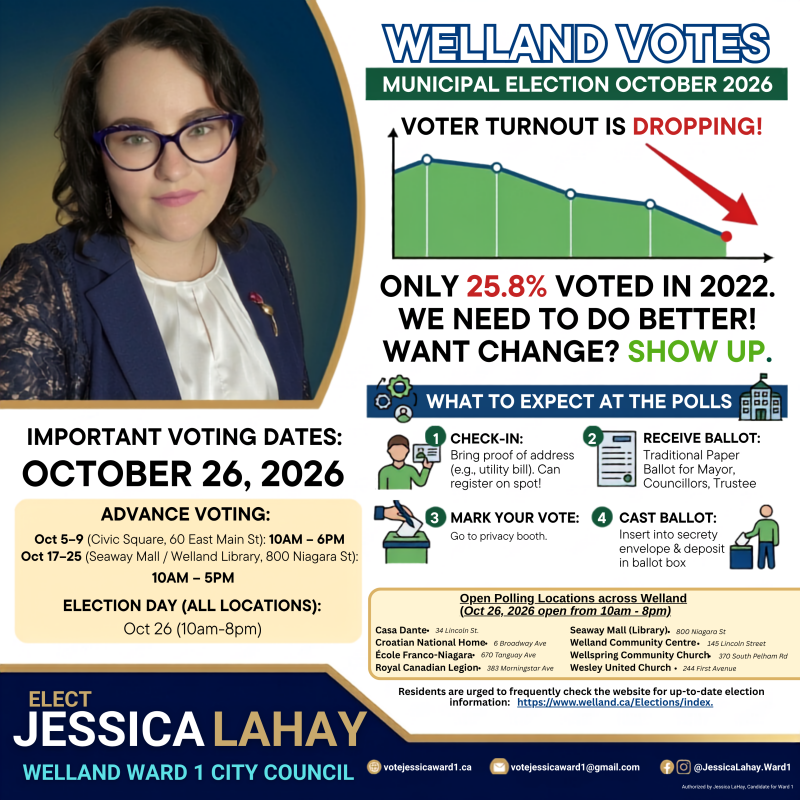
- Civic Square (60 East Main St): Monday, October 5 to Friday, October 9 | 10 AM – 6 PM
- Seaway Mall / Welland Library Branch (800 Niagara St): Saturday, October 17 to Sunday, October 25 | 10 AM – 5 PM
Election Day: Monday, October 26, 2026 (10:00 AM – 8:00 PM) Cast your ballot at any of the eight city-wide locations:
- Casa Dante — 34 Lincoln St
- Croatian National Home — 6 Broadway Ave
- École Franco-Niagara — 670 Tanguay Ave
- Royal Canadian Legion — 383 Morningstar Ave
- Seaway Mall (Library Branch) — 800 Niagara St
- Welland Community Centre — 145 Lincoln St
- Wellspring Community Church — 370 South Pelham Rd
- Wesley United Church — 244 First Ave
Why Showing Up Matters
Real change begins when everyday residents step up to participate. With two extended advance voting windows and open polling on Election Day, casting a ballot fits into virtually any schedule.
Transparency is not optional, and accountability starts with us. Let’s reverse the turnout trend, make our voices heard, and work together to build a responsive, forward-looking Welland.
Add comment
Comments